The Stroop effect game: why going the opposite way is so hard
Read the word, ignore the word, say the colour. It sounds easy and it is not. That stubborn delay is the Stroop effect, one of the most studied findings in psychology. Here is what J. Ridley Stroop actually found, why it happens, and how ARROW RUSH turns a spatial version of it into a 30-second game.
By FLUNG Live team · Updated
What the Stroop effect is
Show someone the word RED printed in blue ink and ask them to name the ink colour. Most people are slower, and make more slips, than when the word matches its ink or when they name the colour of a plain patch. The word is read whether you want to read it or not, and it gets in the way of the answer you were asked for.
That interference is the Stroop effect. Psychologists use the task, and many variations of it, to study attention: how we pick out what matters and hold back a response that comes too easily.
What Stroop found in 1935
John Ridley Stroop, an American psychologist, published the work in 1935 in the Journal of Experimental Psychology under the title “Studies of interference in serial verbal reactions”. He ran three experiments.
- Reading the words. People read lists of colour words aloud, printed either in black or in clashing ink colours. The clashing ink made almost no difference to reading speed.
- Naming the colours. People named the ink colours of clashing colour words, and separately the colours of plain squares. Naming the ink of the words took far longer: in round figures, about 110 seconds for a list of 100 items against about 63 seconds for the squares.
- Practice. After several days of practice at naming the ink colours of words, people got noticeably faster at it, though the interference did not vanish.
The striking part is the lopsidedness. The ink barely disturbs reading, but the word badly disturbs colour naming. Reading is something adults have done many thousands of times a day for years; naming ink colours is not.
Why it happens
There is no single agreed explanation, but the main accounts point the same way. Reading is highly practised and close to automatic, so the meaning of the word arrives quickly and without effort. Naming a colour is slower and needs more deliberate attention. When the two disagree, the fast, automatic response has to be held back while the slower, correct one is produced, and holding it back takes time.
A useful way to think about it: the Stroop effect is what it looks like when a strong habit and a simple instruction pull in different directions. Many everyday slips have the same shape, such as driving to your old address after a move, or typing an old password.
Spatial versions
Researchers have built many relatives of the colour-word task. Some swap colours for space: the word LEFT shown on the right of a screen, or an arrow pointing one way placed on the opposite side. Others ask people to respond away from where something appears. They differ in the details, and psychologists give some of them their own names, but they share the core idea of a fast, habitual response competing with the one the task asks for.
Arrows are a good fit for this, because few symbols are followed as automatically as an arrow. Your thumb wants to go where it points.
How ARROW RUSH uses it
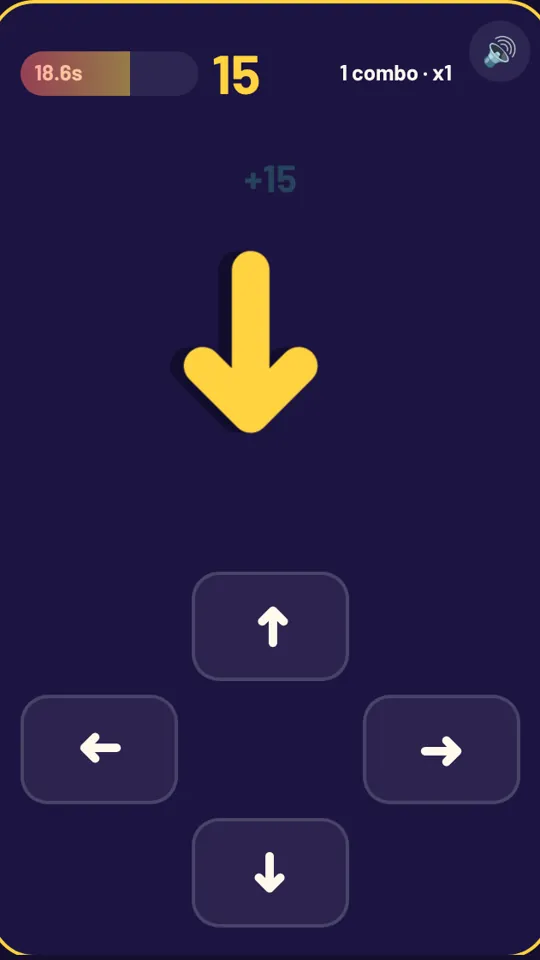
ARROW RUSH is a free browser game built on that pull. One arrow appears at a time, and its colour tells you the rule:
- Yellow: swipe the way it points.
- Red: swipe the opposite way.
- Gold (rare): swipe the way it points, for double points.
On a red arrow, what you see fights what you must do. That is the Stroop-style conflict, in a spatial form: there is no word and no ink, just a direction and a rule given by colour. Strictly, it is a close relative of Stroop’s task rather than the 1935 test itself.
The real rules, taken from the game itself:
- 30 seconds on the clock. There is no game over: you always play the full run.
- Each right answer scores 10 points times your combo multiplier, plus 5 if you answer in under 0.6 seconds.
- Combos build the multiplier: x2 at 5 in a row, x3 at 12 and x4 at 20.
- A wrong swipe resets the combo and takes 1.5 seconds off the clock.
- The first arrows are all yellow. After that, the share of red arrows climbs from roughly one in ten to nearly half as the run goes on, so the conflict gets harder just as you get into a rhythm.
- One run a day. The arrows are dealt from the date in UTC, so everyone gets the same run that day and can compare scores fairly. A new run starts at midnight UTC.
You can swipe anywhere on the play area, tap the on-screen pad, or use the arrow keys on a keyboard. At the end you get a spoiler-free share row, one square per five answers: green for all right, yellow for one slip, red for more. Your best score is kept on your own device and nothing is sent to us.
What practice does, and does not do
Play a few runs and your score will very likely rise. That matches what Stroop saw in his third experiment: practice at a specific conflict task makes people faster at that task. Because the day’s run is the same every time, part of a second-go improvement may also be familiarity with that run.
What we do not claim is just as important. ARROW RUSH is a game. We do not claim it trains your brain in general, raises intelligence, improves memory or concentration in everyday life, or has any health benefit. Getting faster at swiping red arrows makes you faster at swiping red arrows. Play it because it is a fun 30 seconds and a fair contest with friends, not as a treatment for anything.
Tips for a better run
- Check the colour first. Let colour decide the rule before direction decides the swipe. Most slips come from moving on the direction alone.
- Protect the combo. A slip costs 1.5 seconds and resets the multiplier, so one careful answer is often worth more than two rushed ones. The speed bonus is only 5 points.
- Expect more red later. The second half of the run has far more red arrows. Slow down slightly as it builds.
- After a slip, reset. The run carries on, so take the next arrow calmly rather than trying to win the time back in one go.
If you like games where instinct is tested in a fair way, try TIME SHOCK, where you guess the year a real moment happened, or read how closeness scoring works in our estimation games explainer.
Questions
What is the Stroop effect?
The slowdown people show when naming the ink colour of a word that spells a different colour, such as RED printed in blue. J. Ridley Stroop described it in 1935 in the Journal of Experimental Psychology.
Is ARROW RUSH the original Stroop test?
No. It uses a spatial variant: the conflict is between where an arrow points and a rule shown by its colour, not between a word and its ink. The idea underneath, a habit fighting an instruction, is the same.
Does playing train your brain?
We do not claim that. Practice makes people faster at this particular task, but we make no claim that it improves memory, intelligence or health.
Is it the same run for everyone?
Yes. The arrows are dealt from the date in UTC, so everyone who plays on the same day gets the same run, and a new run starts at midnight UTC.