
Estimation games: how closeness scoring works
An estimation game asks for a number you cannot know exactly, then scores you on how close you got. How that closeness is measured decides whether the game feels fair. Here is how FLUNG’s games do it, and how to get better at estimating.
By FLUNG Live team · Updated
What an estimation game is
Estimation games go by many names: guesstimation, “closest wins”, Fermi questions. They all ask for a number nobody carries in their head (how many table-tennis balls stack to the top of the Tokyo Skytree, how many people live in Peru) and reward the guess that lands nearest. Unlike trivia, you do not need to know the answer to do well. You need a sensible chain of reasoning and a feel for scale.
That makes them great for groups. A child and an adult can compete on equal terms, a quiet chat can play as easily as a busy one, and the reveal is a shared moment of surprise rather than a test of who memorised what.
Why not just measure the difference?
The simplest scoring rule is “subtract your guess from the answer”. It breaks down fast. If the answer is 16,000, a guess of 15,000 is 1,000 out and feels excellent. If the answer is 21, a guess 1,000 out is absurd. A points rule based on the difference would need different scales for every question.
Percentages help, but they are lopsided. Guessing 50 when the answer is 100 is 50% too low; guessing 200 is 100% too high. Yet both are “twice out”, and in a game they should feel the same. Worse, a percentage rule caps how wrong you can be on the low side (you cannot be more than 100% too low) but not on the high side.
Scoring by ratio
The fix is to measure how many times off a guess is, on a logarithmic scale. FLUNG’s SHOCK games first work out the error in orders of magnitude:
error = |log₁₀(guess ÷ answer)|
An exact guess has an error of 0. Ten times too high or ten times too low both have an error of 1. Twice too high and half both come out at about 0.3. The rule is symmetric, works on every question whatever its size, and treats “too big” and “too small” equally.
The points then follow a gentle curve:
points = 100 ÷ (1 + 1.5 × error), rounded to a whole number.
The curve never reaches zero for an honest guess, so even a wild guess scores something, while being close still matters a great deal. The 1.5 controls how steep the curve is; it was chosen so that exact scores 100, twice out scores 69 and ten times out scores 40.
The points table
These values are calculated live by the same function the games use.
| How far off | Points |
|---|---|
| Exact | 100 |
| 1.25 times (25%) off | 87 |
| 1.5 times off | 79 |
| Twice (or half) | 69 |
| Three times off | 58 |
| Five times off | 49 |
| Ten times off | 40 |
| A hundred times off | 25 |
| A thousand times off | 18 |
Two things stand out. The first steps away from exact cost the most: going from 1.5 times off to exact is worth far more than going from 100 to 1,000 times off. And the curve is forgiving at the far end, which keeps everyone in the game. In DAILY SHOCK you can also back yourself, which multiplies a close round’s points up (to a maximum of 100) and a far one’s down.
No speed bonus
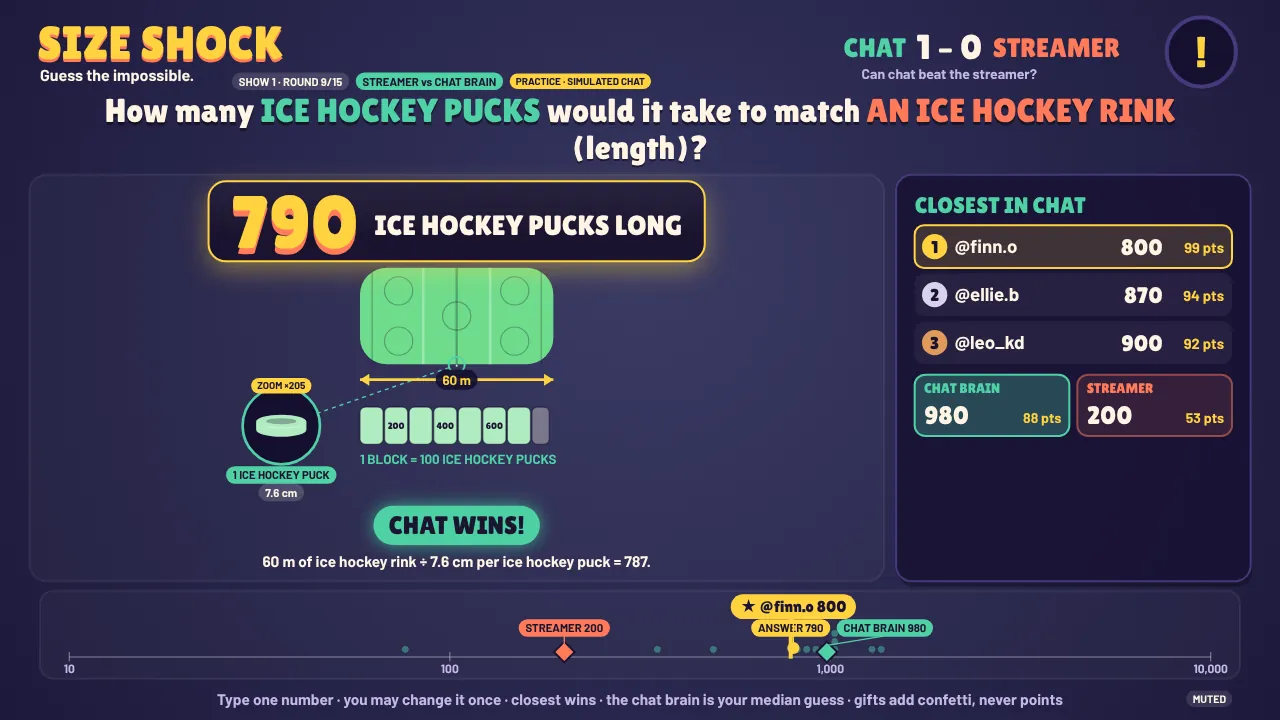
Many quiz games award extra points for answering quickly. FLUNG’s estimation games deliberately do not. On a stream, chat arrives with a delay that varies by viewer and device; a speed bonus would reward a good connection, not a good guess. At a family table, it would reward the fastest typist over the most thoughtful one. Every guess made inside the window scores on closeness alone, and you can change your guess once before the lock.
How to estimate better
- Find the order of magnitude first. Tens, hundreds or thousands? Getting this right already guarantees a decent score.
- Break it into steps. How many of the small thing in a metre? How many metres in the big thing? Multiply.
- Use reference points. A door is about 2 m tall; a double-decker bus about 4.4 m; a football pitch about 100 m long. Anchoring on a known size beats guessing from nothing.
- Lean against your bias. Small objects usually feel bigger than they are, so guesses for “how many small things” tend to come out low. Nudge up.
- Average your own guesses. Make two estimates in different ways and take the number in between (in ratio terms). It is the wisdom of crowds with a crowd of one; read more in our wisdom of crowds explainer.
Questions
Is there a speed bonus?
No. Every FLUNG estimation game scores closeness only, so a careful guess at the last second scores the same as a fast one.
Why does being twice too high score the same as half?
Because the score uses the ratio between your guess and the answer, and 2 and 0.5 are the same distance from 1 on a log scale.
What counts as a guess in chat?
The first number in a message: 42, 1,200, 1.5k and 2m all work. Links and emotes are skipped.