
Family game night ideas: a plan that works for every age
A good family game night is less about which games you pick and more about how the evening is shaped. A warm-up, a few games and a final give it a beginning, a middle and an end, and somebody to crown. Here is a structure that works, the house rules that keep it fair, and an honest look at when phones help and when to leave them in a drawer.
By FLUNG Live team · Updated
The shape of a good game night
Most game nights that fizzle out do so for the same reasons: they start cold, one long game drags on, and nobody knows when it is over. A simple three-part structure fixes all three.
- A warm-up (5 to 10 minutes). Something quick that everyone can play while the last person sits down. It sets the mood and gets people laughing before anything counts.
- Two to five short games. Variety beats length. A guessing game, then something with words, then something a bit chaotic gives everyone a turn to shine. If your family loves one game, play it twice rather than once for twice as long.
- A final. End on purpose. A final game, a deciding round or a rematch between the top two tells everyone the night is nearly over and gives it a peak.
Keep a running score across the whole night, not just inside each game. A paper scoreboard on the fridge works; so does letting a game keep it for you.
Warm-up ideas
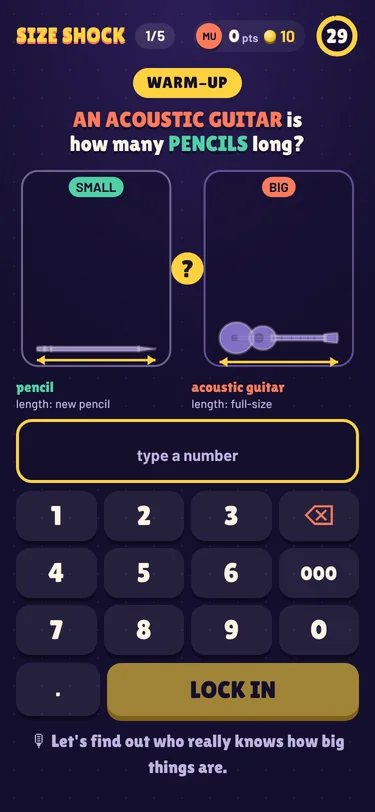
- Closest guess wins. Hold up a jar of pasta, a bag of sweets or a full bookshelf and ask how many. Everyone writes a number; closest wins the first point of the night.
- Categories. Pick a letter and a category (animals, foods, places) and go round the table until someone is stuck.
- One-minute draw. Everyone gets the same word and sixty seconds to draw it. Vote on the best, then the worst.
- A practice round. If you are playing on phones, the first round can be the warm-up. More on that below.
Running it with GAME NIGHT
FLUNG Party has the three-part shape built in. When you host on the Party page, choose Game night instead of One game and tap two to five games to build a playlist. You can reorder them, or use a ready-made one:
- Quick 2: SIZE SHOCK, then WEIGHT SHOCK. Two guessing games, good for a school night.
- Classic 3: SIZE SHOCK, TIME SHOCK and WEIGHT SHOCK: sizes, years and weights.
- Epic 5: adds HIVE MIND and WORLD SHOCK for a full evening.
You also pick 5, 8 or 12 rounds per game and whether people play for themselves or in teams. Everyone joins once, from one link or QR code, and stays in the same room for the whole night. A practice round runs first by default and never counts, which makes a natural warm-up.
After each game, cups go to the top three: 3 for first, 2 for second and 1 for third. A strip at the top shows where you are in the playlist, and the table of cups carries across games. After the last one, the player with the most cups is the Family Champion. If nobody wants to stop, Another game night replays the same games with the same players and resets the cups.
Outside a playlist, a podium ends each game with a vote on what to play next, so the room decides together. FLUNG OUT, LETTERBLAZE and SNEAKY SWAP play as single games for now, so slot them in before or after a playlist. Our guide to party games for teenagers covers FLUNG OUT, the arena game where the last ball standing wins.
Knockout cup mode
For a final with real tension, try Knockout cup under Play as. Instead of everyone racing for points, players are drawn into 1v1 duels. Each question, the higher score of the two wins it, and the first to two wins goes through: quarter-final, semi-final, final. With an odd number, one player gets a bye. It needs at least two players and works with the SHOCK games, HIVE MIND, TIME SHOCK and MIXED.
Players who are knocked out keep answering for fun, so nobody is sent to sit on the stairs. A cup suits families with a competitive streak, and it gives a younger player a real chance: one good duel against an older sibling is all it takes.
House rules
Agree these before you start, not in the middle of an argument.
- The youngest picks first. Who goes first, which game opens, which team they join.
- Mixed-age teams. Put the strongest players on different teams, or pair each child with an adult.
- A champion’s handicap. Last week’s winner sits out the warm-up, or plays with one hand behind their back in anything physical.
- No phones except to play. If you are using phones as controllers, agree that messages wait until the end.
- Gentle mode for younger children. In Party, the host can turn it on so captions stay neutral, with no teasing.
- Good losers get a say. Whoever comes last picks the final, or the snack for next time.
Snacks and timing
With younger children, about an hour is plenty: ten minutes of warm-up, three short games and a final. Start early enough that nobody is overtired by the last game, because tired children and close finishes are a poor mix. Older children and adults can go longer, but it still helps to decide the end point in advance.
Choose snacks that do not need cutlery or leave greasy fingers on cards and screens: popcorn in individual bowls, fruit, breadsticks, a tray of something from the oven between games. A short break between the main games and the final is a good moment to bring out the pudding, and it builds a bit of suspense before the decider.
Phones or phone-free?
Phones make excellent controllers. Everyone has a private screen, so guessing and quiz games work without anyone peeking, and nobody waits for a turn. Nothing needs to be set out or tidied away, and family members in another house can join the same game. For mixed ages, games where everyone answers at once and the reveal is shared are hard to beat.
But phone games are not always the right call. Go phone-free when:
- the youngest players do not have phones and sharing would leave them as spectators;
- phones keep pulling people into messages and social media, and the night becomes everyone on their own screen;
- the point of the evening is a break from screens after a long week;
- you want slow, chatty games with plenty of table talk, where a board or a pack of cards does the job better.
Or alternate: a phone game night one week, cards and board games the next. If you do go with phones, the phone party games guide covers hosting and adding a TV, and our Christmas games for the whole family guide puts all of this into a plan for the big day.
Questions
How long should a family game night be?
With younger children, about an hour is plenty: a warm-up, two or three short games and a final. Older children and adults can happily go longer.
What is GAME NIGHT in FLUNG Party?
A playlist of two to five games played back to back in one room. Each game awards cups, 3 for first, 2 for second and 1 for third, and whoever has the most cups at the end is the Family Champion.
Should family game night be phone-free?
Sometimes. If phones keep pulling people into messages, or the youngest do not have one, a board or card game night is the better choice. Phone games work best when everyone has a screen and the game ends in a shared reveal.
What if the same person always wins?
Change the house rules: mixed-age teams, a handicap for last week’s champion, or a knockout cup where every duel is a fresh start.