
The guess the year game: how it works and how to win
A moment from history appears. You type the year. Then every guess lands on one timeline and the real year drops in. That is the whole game, and it works for a child and a grandparent at the same table. Here is how TIME SHOCK plays, how its scoring scales with time, and how to guess better.
By FLUNG Live team · Updated
What a guess the year game is
Search for a guess the year game and you mostly find phone apps to download, or articles about guessing when an old photo was taken. The idea is simple and old: show people a moment, ask when it happened, and see who lands closest. It is a cousin of the estimation game, with years in place of sizes or populations.
What makes it good with a group is that nobody needs to know the answer. Most people cannot tell you the year the first cash machine opened, but almost everyone has a feel for whether it came before or after the Moon landing. That feel is what the game rewards, which is why it suits mixed ages so well.
TIME SHOCK is our version. It is free, runs in the browser with no app and no sign-up, and is built to be played together, with everyone on their own phone.
How TIME SHOCK plays
- A moment appears. Each card is a real, well-documented event written in our own words: the first text message, the Titanic sinking, Magna Carta. Many cards carry a real photograph from Wikimedia Commons under a free licence, credited after the reveal.
- Everyone types a year. The keypad has an AD and BC switch, and shortcut keys for 19__ and 20__ so recent years take two taps.
- The timeline. Every guess is placed on one line, the real year drops in, and each guess shows how many years too early or too late it was. An exact year is a BULLSEYE.
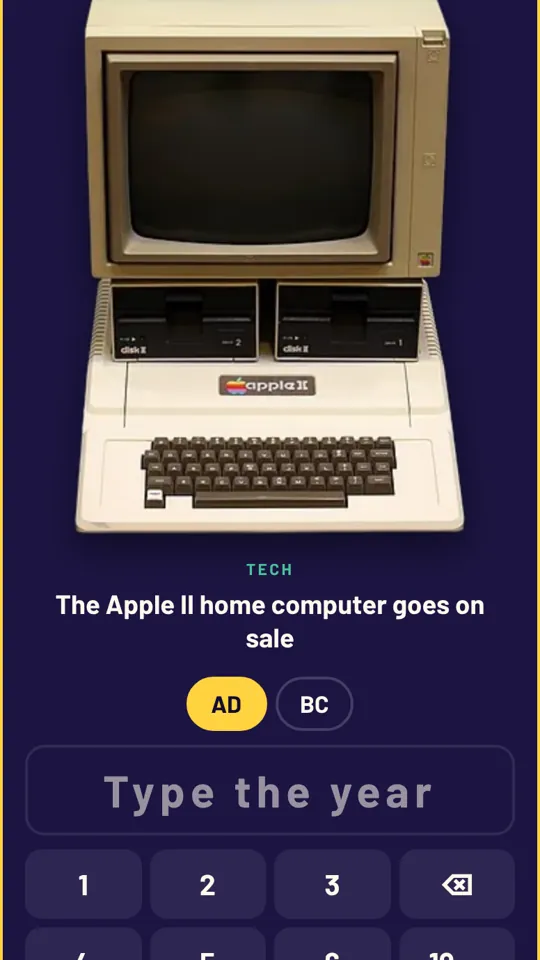
You can play five cards on your own right now on the TIME SHOCK page: an easy-to-hard hand with a total and a spoiler-free share line at the end. To play with other people, host it in FLUNG Party, where up to 20 phones can join one game.
How the scoring scales with time
A fair guess the year game cannot score every card the same way. Being five years out on something from last decade is a poor guess. Being five years out on something from the 1200s is excellent. So TIME SHOCK gives every card its own window, based on how long ago it happened:
window = 35% of the years since the event, and never less than 20 years
An exact year scores 100. Inside the window, points fall on a smooth curve from 95 down to 0 as your guess moves away from the answer: points = 95 × (1 − distance ÷ window)1.4, rounded. At the edge of the window and beyond, the card scores 0.
That means anything from the late 1960s onwards has the minimum 20-year window, so recent cards are the sharpest test. Older cards widen out: Magna Carta has a window of 284 years and the Great Pyramid one of 1605 years. The curve is steepest near the answer, so the first few years of error cost the most, and a guess in roughly the right era still earns something.
Worked examples
These points are calculated live by the same function the game uses.
| Moment | Answer | Window | Guesses and points |
|---|---|---|---|
| Humans walk on the Moon | 1969 | 20 years | 1968: 88 · 1965: 70 · 1979: 36 |
| The Titanic sinks | 1912 | 40 years | 1910: 88 · 1925: 55 · 1950: 1 |
| King John agrees to Magna Carta | 1215 | 284 years | 1200: 88 · 1300: 58 · 1400: 22 |
| The Great Pyramid of Giza is finished | about 2560 BC | 1605 years | 2500 BC: 90 · 2000 BC: 52 · 3000 BC: 61 |
Compare the Moon landing and Magna Carta. One year out on the Moon landing scores 88; fifteen years out on Magna Carta scores 88. Ten years out on the Moon landing drops to 36, and twenty years out scores 0. Eight centuries back, by contrast, guessing 1300 for Magna Carta, 85 years out, still scores 58.
BC works the same way. The Great Pyramid is dated by historians to a range, so its answer shows as about 2560 BC. Guess 2500 BC and you score 90; guess 3000 BC, more than four centuries out, and you still score 61.
How to guess better
- Anchor on a date you know. Find a nearby event you are sure of and ask: before or after? If you know the Moon landing was 1969, you can place a lot of 20th-century cards just by asking whether they came before or after it.
- Pick the decade first, then the year. Most points are won or lost on the decade. Settle on it, then adjust inside it. Do not spend your time choosing between 1983 and 1984 if you are not sure it was the 1980s.
- Read the photo. On photo cards the object itself is evidence: the materials, the shape, how chunky the technology looks, whether the picture is colour or black and white.
- Think in generations. Would your grandparents remember it as children? Your parents? Thinking in lifetimes is a quick way to land in the right era.
- Lean slightly earlier on recent events. Memory researchers call one common slip forward telescoping: things we remember often feel more recent than they were. If a card from your own lifetime feels like it was about ten years ago, check whether it might be fifteen.
- For BC, think in thousands. The window on ancient cards is wide, so the right millennium matters far more than the exact century. Remember there is no year zero: 1 BC is followed by AD 1.
Playing together
The timeline is the point of playing with other people. In FLUNG Party, every phone shows the same card, everyone types a year privately, and the reveal puts every guess on one line, on each phone and on a TV if you open the big screen. Someone is nearly always decades out, and that is usually the moment the room remembers.
To host, open the Party page with TIME SHOCK picked, type your name and choose 5, 8 or 12 rounds. Send the link or show the QR code; players type a name and they are in. You can play everyone for themselves, in teams, or as a knockout cup of 1v1 duels. A practice round that does not count is on by default for new rooms, which helps first-timers find the BC switch.
TIME SHOCK also sits in GAME NIGHT, where several games play back to back with cups for each one. Our family game night ideas guide covers how to plan one. And if you like closeness scoring, the estimation games explainer shows how the number games score by ratio instead of distance.
Questions
Is the guess the year game free?
Yes. TIME SHOCK runs in the browser with no app and no sign-up. Try five cards on its page, or host a game for up to 20 phones in FLUNG Party.
How is a guess scored?
Each card is worth up to 100 points, and the exact year scores 100. Every card has a window of 35% of how long ago it happened, never less than 20 years; inside it, the closer you are the more you score, and outside it you score 0.
Can I guess a year BC?
Yes. Tap BC before you type the year. The oldest moments, such as Stonehenge or the Great Pyramid, are dated by historians to a range, so their answer is marked as approximate.
Are the photos real?
Yes. Photo cards use real photographs from Wikimedia Commons under free licences. Each credit is shown after the reveal and on our photo credits page.