
The size comparison game: how many of one thing make another?
How many tennis nets tall is the Eiffel Tower? How many pucks fit along an ice rink? A size comparison game asks one question about two real things, and the answer is almost always more surprising than you expect.
By FLUNG Live team · Updated
How the game works
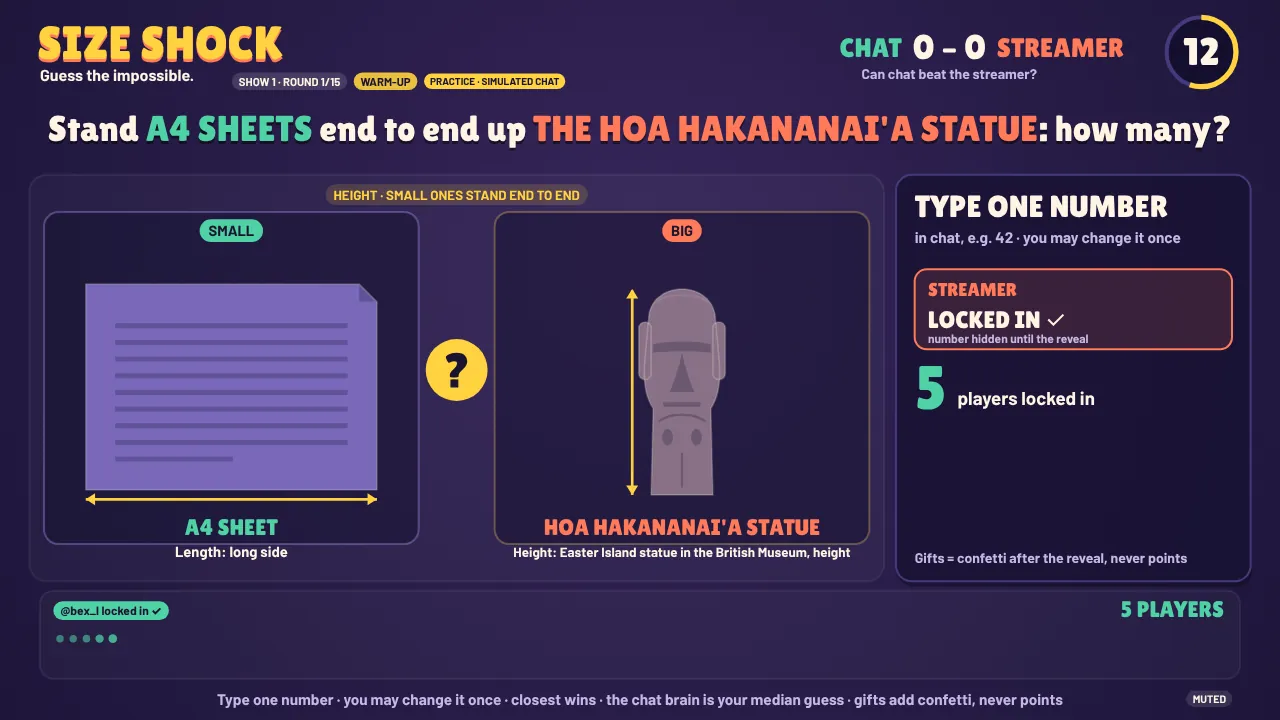
A size comparison game shows two objects, one small and one big, and asks how many of the small one it would take to match the big one, end to end or stacked up. The twist in SIZE SHOCK is that both objects first appear at the same size, side by side in matching boxes. Your eyes cannot do the maths for you; you have to imagine the real sizes.
Everyone types one number. In a stream, viewers type it in chat; in Party mode, each player has a keypad on their phone; in DAILY SHOCK, you play on your own. Guesses stay hidden until the lock, so nobody can copy.
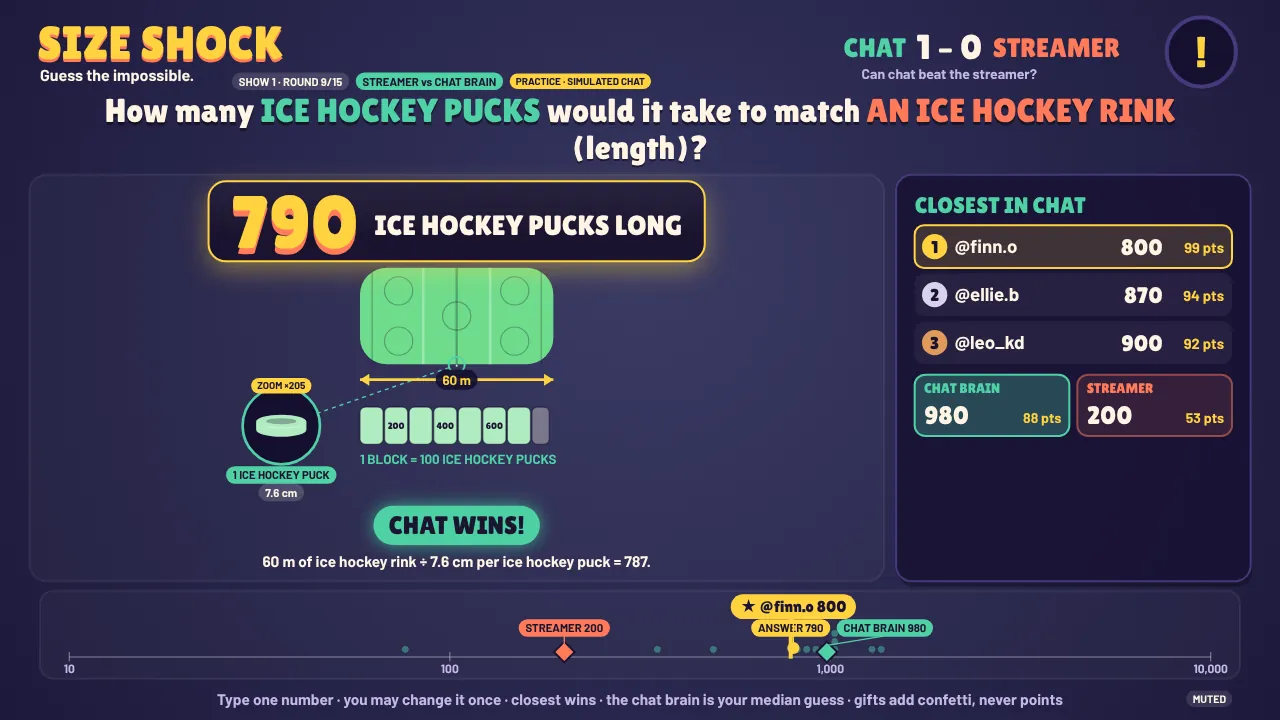
Then comes the part that makes the format work: the view snaps to true scale. The small object shrinks to its real size next to the big one, the count builds up, and the working is shown on screen, for example “60 m of ice hockey rink ÷ 7.6 cm per puck = 787”. Every guess is placed on a measuring line, so you can see at a glance who was close and who was wildly out.
Worked examples
These come from SIZE SHOCK’s launch pack, where every object has a sourced measurement. Try guessing each one before reading the answer column.
| Question | Big | Small | Answer |
|---|---|---|---|
| Tennis nets to the top of the Eiffel Tower | 330 m (official landmark figure) | 0.914 m (Rules of Tennis, net height at the centre) | about 360 |
| Ice hockey pucks along a rink | 60 m (international rules) | 7.6 cm (3 inches, official rules) | about 790 |
| Table-tennis balls up the Tokyo Skytree | 634 m (official height) | 40 mm (official rules) | about 16,000 |
| A4 sheets along the Natural History Museum’s blue whale skeleton | 25.2 m (Natural History Museum, London) | 297 mm (ISO 216) | about 85 |
| Plutos across Uranus | 50,724 km (NASA fact sheet) | 2,376 km (NASA fact sheet) | about 21 |
The answers are simple divisions: 330 ÷ 0.914 is about 361, which the game shows to two significant figures as 360. The fun is how far instinct can be from these numbers. A tennis net feels taller than its 91 cm, which pulls Eiffel Tower guesses down, and it is hard to make your imagination reach 16,000 for the table-tennis balls.
Why our size instincts fail
We are good at comparing things of similar size: two apples, two cars. We are poor at ratios that run into the hundreds or thousands, because we rarely see both objects together. Three effects make it worse:
- Small things feel bigger than they are. We remember objects at arm’s length, so a puck or a table-tennis ball takes up more of our mental picture than its few centimetres.
- Big things get compressed. Tall buildings and planets are seen from far away, and the brain does not scale the memory back up properly.
- Area and length get mixed up. If something is ten times longer, its area is a hundred times bigger and its volume a thousand. Many wild guesses come from answering a volume question when the game asked about length.
Weight comparisons (how many of one thing weigh as much as another) trip people up in exactly the same way, which is why “how many X make a Y” questions are such good party material.
How to guess better
- Check the measurement. SIZE SHOCK tells you what is being measured: height, length or diameter, and from where to where. A net is measured at the centre, a whale end to end.
- Pick a stepping stone. Convert the small thing into something you know. Eleven tennis nets is about 10 metres; then ask how many 10-metre steps make the Eiffel Tower.
- Multiply two easy guesses. “About 33 tens” beats one heroic leap from a net to a tower. Two rough estimates multiplied are usually closer than one.
- Think in powers of ten. Is the answer in the tens, hundreds or thousands? Getting the order of magnitude right already scores well, because closeness is judged on a ratio.
The scoring rewards exactly this kind of thinking. An exact answer scores 100, twice too high or low scores 69, and ten times off still scores 40. There is no speed bonus. Our explainer on how estimation scoring works shows where those numbers come from.
Where to play
- On stream: SIZE SHOCK runs as an OBS browser source on Twitch. Chat guesses, and chat’s combined answer, the Chat Brain, takes on the streamer.
- With friends and family: Party mode puts SIZE SHOCK on everyone’s phone, with stacks of each player’s guess drawn next to the real thing.
- Every day: DAILY SHOCK includes SIZE SHOCK questions on many days, alongside WORLD SHOCK.
Questions
Where do the sizes come from?
SIZE SHOCK’s launch pack uses sourced measurements for every object, and the reveal shows the working, for example 60 m of rink divided by 7.6 cm per puck.
Why are both objects shown at the same size?
So your eyes cannot do the maths for you. The question is the ratio, and the reveal zooms to true scale to show it.
What is a good guessing strategy?
Break the big thing into steps you know: how many of the small one in a metre, then how many metres. Multiplying two easy guesses usually beats one hard one.
Can I play it with friends?
Yes. SIZE SHOCK runs on Twitch with chat, in Party mode on everyone’s phone, and in DAILY SHOCK on some days.