
The population guessing game: how well do you know the world?
How many people live in Spain? Is Canada more crowded than the Netherlands? Population and geography guessing games are a gentle way to discover how far our mental map has drifted from the real world.
By FLUNG Live team · Updated
How the game works
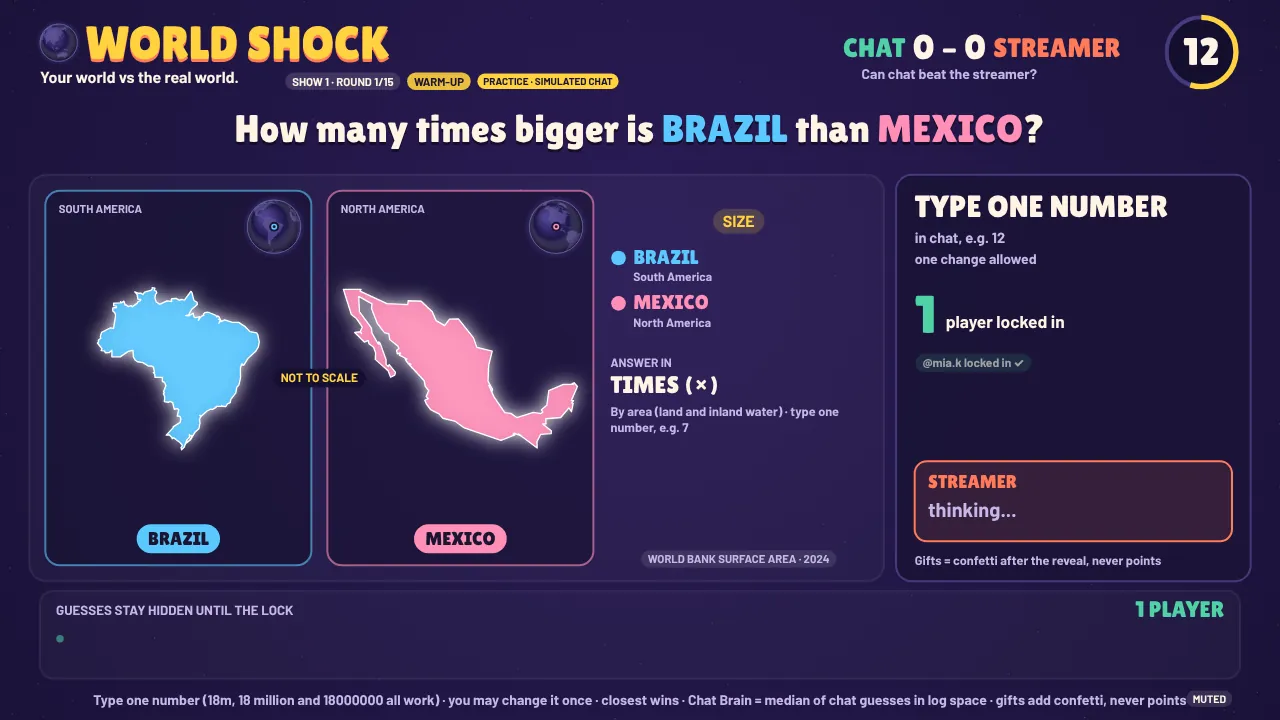
A geography guessing game asks for one number about the planet, and the closest guess wins. In WORLD SHOCK the questions cover populations, how many times one country fits inside another, distances between capitals, incomes and how crowded a country is. The source and year are always on screen.
The reveal is called YOUR WORLD vs REAL WORLD. Before the true answer appears, each guess is drawn as what it would mean: a country filled with your guessed number of people, a country inflated to the size you said, a flight that lands in the sea because you guessed the distance short. Then the real figure snaps in.
Try a few
Cover the right-hand column and guess each population. All figures are World Bank totals for 2024, the same data WORLD SHOCK uses.
| Country | Population, 2024 (World Bank) |
|---|---|
| Spain | 48.8 million |
| Peru | 34.2 million |
| Canada | 41.3 million |
| Australia | 27.2 million |
| Nigeria | 232.7 million |
| Indonesia | 283.5 million |
Two more to test your sense of area. Brazil is about 4.3 times the size of Mexico by surface area (8.51 million km² against 1.96 million km²). Canada has about 4.7 people per km² of land; the Netherlands has about 534. Most people get the direction right and the size of the gap wrong.
Why our guesses drift
A few patterns show up again and again, and you will probably spot them in your own guesses:
- Anchoring on home. We judge other countries against the one we know. Someone in the UK, home to about 69 million people, may guess Spain close to the UK, then be surprised it is about 49 million.
- Maps distort size. The common web map projection stretches countries near the poles. Canada and Russia look bigger than they are relative to countries near the equator, so area questions about Africa and South America often get guessed low.
- Old numbers stick. Populations change. A figure learnt at school can be decades out of date, which is why WORLD SHOCK shows the year with every answer.
- Big numbers blur. Beyond a few million, numbers stop feeling different. 34 million and 340 million can sound similar, though one is ten times the other.
Where the numbers come from
A geography game is only as good as its answers. WORLD SHOCK uses official sources only:
- World Bank indicators for population, surface area, income (GNI per person) and population density, with the year on screen.
- Great-circle distances between capital cities, the shortest path over the globe.
- NCD-RisC for the rare round about average height.
Scores use the exact figure, even when the screen shows a rounded one. Where a figure is ambiguous, for example a country with more than one capital or a disputed area, that question is left out.
Tips for better guesses
- Use a reference country. Know a handful of populations well (your own, plus a big and a small neighbour) and guess relative to them.
- Think in orders of magnitude. Is it tens of millions or hundreds? Closeness is scored on a ratio, so landing in the right band already scores well.
- Picture the globe, not the flat map. Countries near the equator are bigger than the map suggests.
- Type big numbers the easy way. 18m, 1.4b and 52k all count, and 7,800 km works for distances.
A note on distances
Distance rounds catch out even confident players. WORLD SHOCK measures the great-circle distance between two capitals: the shortest path over the curved surface of the Earth, which is roughly what a long-haul flight follows. On a flat map that path looks curved, and the straight line you picture is usually longer or shorter than the real route. A useful anchor is that London to New York is roughly 5,600 km, and the Earth is about 40,000 km around. If your guess for two capitals on opposite sides of the world comes out above 20,000 km, it is too big: nowhere is further away than half the planet.
Where to play
WORLD SHOCK runs on Twitch as a chat game, where chat’s combined answer goes head to head with the streamer. Add &tone=gentle to the link for plain captions, which suits classroom and family streams. It also appears in FLUNG Party on everyone’s phone and in DAILY SHOCK, the shared daily puzzle.
Questions
Where do the numbers come from?
Official sources only: World Bank figures for population, area, income and density, with the year on screen, and great-circle distances between capitals.
Why do people guess populations so badly?
Big numbers are hard to picture, so we anchor on places we know. A useful habit is to compare with a country whose number you do know.
Is it suitable for a classroom or family stream?
Yes. Add &tone=gentle to the overlay link and the captions stay plain, with no jokes.
Does it work without a stream?
Yes. WORLD SHOCK is in Party mode for phones and appears in DAILY SHOCK.