
Games to play with viewers on stream: the formats that work
Playing with your viewers rather than in front of them changes the feel of a stream. Here are the formats that reliably get a chat talking, what each one needs, and how to run a round so it lands.
By FLUNG Live team · Updated
Why play with viewers at all
Most of the time a stream is a performance: you play, chat comments. That works, but it leaves the people watching with only one job, which is typing reactions into a box that scrolls past. Viewer games flip that. For a few minutes the audience is part of the show, their names are on screen, and what they type changes what happens next.
It also solves practical problems. A viewer game gives you something to do at the start of a stream while people arrive, a break between matches, a way to fill a queue, and a reason for a lurker to type for the first time. A first message is the hardest one to get; “type a number” is about the lowest barrier there is.
The trick is picking a format that fits your audience and your content. A competitive shooter stream and a cosy art stream want different things, and a chat of eight behaves very differently to a chat of eight hundred.
Four formats that work
1. Guessing games
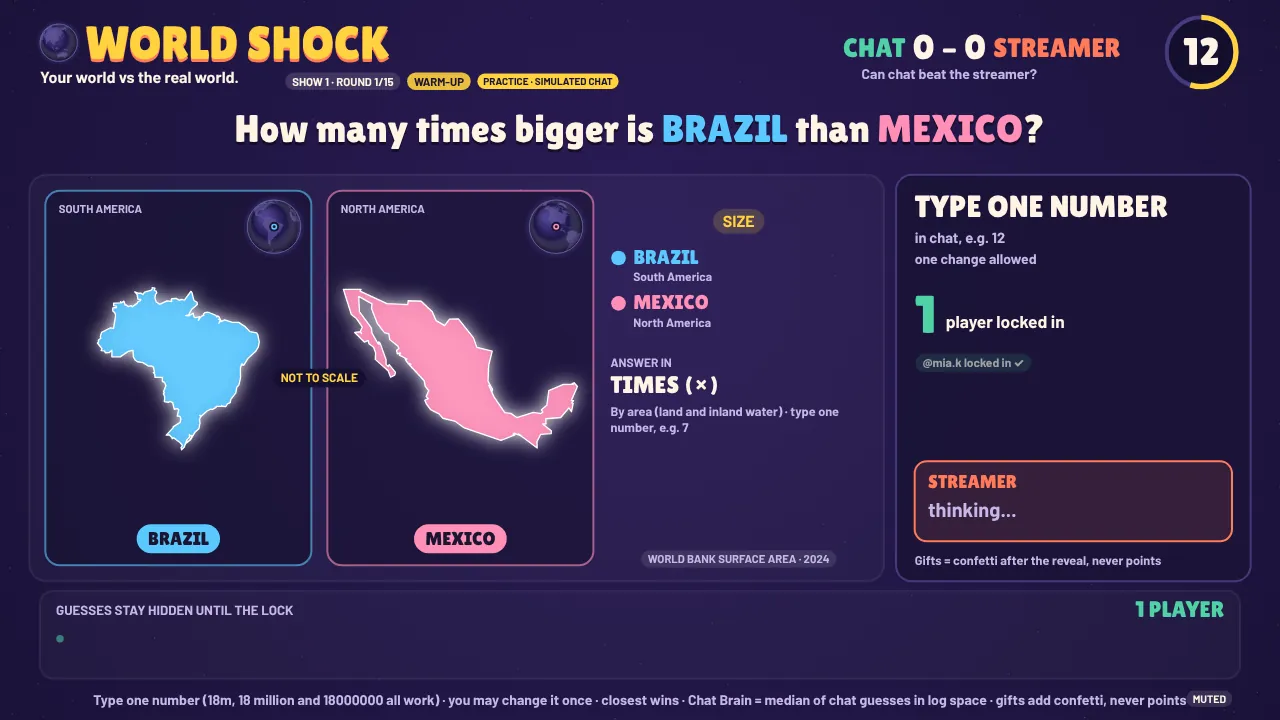
Everyone answers the same question with a number, and the closest wins. This is the most forgiving format: it needs no prior knowledge, works with any chat size, and every guess scores something if the game scores by closeness. SIZE SHOCK asks how many of one thing make another (table-tennis balls to the Tokyo Skytree, pucks to a rink). WORLD SHOCK asks one number about the planet, from official sources with the year on screen.
2. Crowd-matching games
There is no right answer, only the most popular one. A prompt appears, everyone types one answer, and you score for agreeing with the crowd. It is the family-quiz-show format, adapted to chat. HIVE MIND merges chat’s answers into bubbles, sized by how many people gave them; typos and UK or US spellings join the right bubble. The streamer’s job is to predict chat’s number one before the reveal, which turns into a test of how well you know your own community.
3. Team games
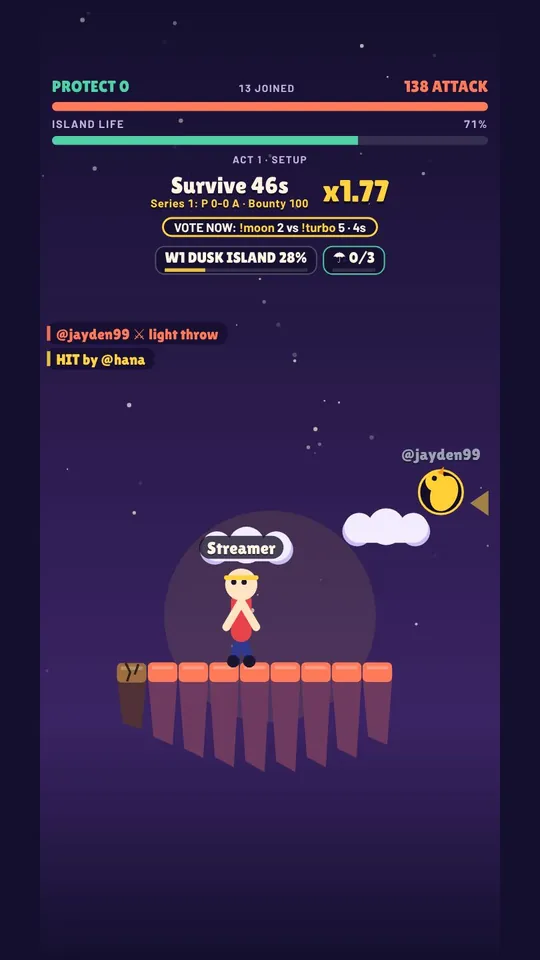
Chat splits into sides and pulls against each other. This suits louder, faster streams where viewers enjoy a bit of chaos. In FLUNG Island viewers type 1 to protect your hero’s island or 2 to attack it, then use free moves such as !duck and !throw. Every move carries the viewer’s name, and a round lasts 60 seconds.
4. Votes and polls
Twitch’s built-in polls and predictions are the simplest form of viewer play: chat chooses, and you live with the result. They are excellent for decisions inside your own game (which route, which build) and need no set-up at all. Their limit is that a poll has no round structure, no score and no names on screen, so they work best as a seasoning rather than a whole segment.
Which format suits your stream
| Format | Chat size | Best for | Viewer types |
|---|---|---|---|
| Guessing | Any, from 2 up | Starts of streams, breaks, family-friendly channels | One number |
| Crowd-matching | About 5 and up | Chatty communities, just chatting, quiz nights | One short answer |
| Teams | About 10 and up | High-energy streams, raids, events | 1 or 2, then free moves |
| Polls | Any | Decisions inside your own game | A choice |
The chat sizes are rules of thumb from how the formats work, not hard limits. A guessing game technically works with one viewer, because there is still a closest guess and a streamer to beat. A crowd-matching game needs a few answers before the bubbles mean anything.
How to run a round
- Announce it. “Game time: type one number in chat, closest wins.” Say it once and let the overlay do the rest.
- Read the question out. Viewers watching on a phone may not be able to read small text. Saying it also builds a tiny moment of tension before the timer.
- Make your own guess. In the SHOCK games your guess is locked and hidden; in HIVE MIND you predict chat’s top answer. Playing along is what turns “a quiz” into “us against the streamer”.
- Celebrate the reveal. Name the closest viewer, tease the wildest guess (kindly), and note whether chat beat you. Callbacks to earlier rounds give the show a story.
- Stop while it is fun. A show of about ten minutes leaves people wanting another. You can always run a second one later in the stream.
Keeping it fair
Viewer games fall apart when they feel rigged. Three rules keep them honest:
- Hide answers until the lock. If guesses are visible, the first confident number gets copied and the game becomes a race. Hidden guesses make every answer independent, which is also what makes the crowd’s combined guess so good (see the wisdom of crowds).
- Do not let money buy points. Gifts and Bits are a lovely way for viewers to support you, and the FLUNG games celebrate them on screen, but a gift never changes a score in SIZE SHOCK, WORLD SHOCK or HIVE MIND. Viewers who cannot spend can still win every round.
- No speed bonus. Rewarding the fastest answer favours people on desktop with low latency. Closeness-only scoring means a thoughtful guess typed in the last second is worth exactly the same as an instant one.
Pick one format, run it for a couple of streams, and watch which viewers start typing who never did before. That is usually the clearest sign it is working.
Questions
What is the easiest game to play with a small chat?
A guessing game. One number per person works with three viewers or three hundred, and the closest guess wins even when only two people play.
How long should a viewer game last?
Short rounds inside a ten-minute show work well: a SIZE SHOCK or WORLD SHOCK round is 37 seconds and a 15-round show runs about 10 minutes.
How do I stop trolls ruining a chat game?
Pick games built for it. The SHOCK games use the median guess, so one silly number cannot drag the chat answer, and HIVE MIND only shows answers that several people gave.
Can viewers win without paying?
Yes. In every FLUNG game chat can win without spending. In SIZE SHOCK, WORLD SHOCK and HIVE MIND a gift is celebrated after the result locks and never changes a score.